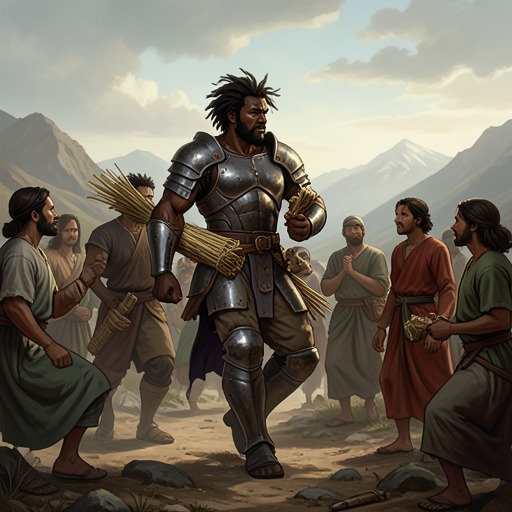
Ammon son of Mosiah
Book of MormonAmmon son of Mosiah is one of the four sons of Mosiah—alongside Aaron son of Mosiah, Omner, and Himni—whose lives are redirected from royal privilege and earlier opposition to the Church of Christ toward missionary service. His decisive significance lies in the way his conversion becomes practical ministry: repentance does not merely change his beliefs, but sends him into the land of Ishmael among the Lamanites, where patient service and revealed teaching open a path toward King Lamoni’s conversion.
Identity and Calling
Ammon son of Mosiah is identified as one of the sons of Mosiah, a family group whose members become central missionaries to the Lamanites. His identity is therefore inseparable from a political question as well as a religious one. When the people of Nephi express their desire that Aaron son of Mosiah should be their king and ruler, Ammon belongs to the royal household whose succession could have continued the monarchy. Instead, his story develops in the direction of relinquished status and service rather than inherited rule.
The larger narrative places Ammon within a generation wrestling with belief, authority, and inner change. Those who refuse belief cannot understand the word of God because their hearts are hardened, while Alma the Younger recalls that faith brought a mighty change in the heart of his father, Alma the Elder. Ammon’s own trajectory is presented in this same moral vocabulary. He has repented, has been redeemed of the Lord, and has been born of the Spirit. His missionary work thus functions as evidence that conversion is not an abstract declaration but a durable reorientation of conduct and purpose.
Mission Among the Lamanites
The sons of Mosiah travel during the fourteenth year of the reign of the judges, and after meeting with Alma the Younger they take separate journeys throughout the land. Ammon goes to the land of Ishmael, a place named after the sons of Ishmael, who had become Lamanites. The decision places him beyond the security of his own people and among a population with whom the Nephites have a history of hostility and religious division.
His mission begins under conditions of substantial uncertainty. Ammon does not arrive as a ruler demanding recognition, nor as a military representative seeking submission. He enters the land as a servant. That choice gives the narrative its central reversal: a man connected to Nephite kingship accepts a subordinate position among the Lamanites, and the apparent loss of rank becomes the means through which he gains access to a king and his household.
Service to King Lamoni
King Lamoni is greatly pleased with Ammon and orders that his bands be loosed. The king even offers Ammon one of his daughters in marriage. The offer reveals how quickly Ammon’s conduct has altered his standing: he is no longer treated as a suspected outsider or captive, but as a trusted figure worthy of incorporation into the royal family. Yet the narrative emphasizes his continuing commitment to serve the people rather than accept royal marriage as the goal of his mission.
Ammon’s service is tested in the care of King Lamoni’s flocks. His work is not ornamental. It exposes him to the consequences of failure and to the violence directed against the king’s servants. When the flocks are scattered and the servants face the possibility of death, Ammon acts to preserve both the animals and the lives entrusted to him. His courage is therefore expressed through protection and labor before it is expressed through formal preaching.
The servants’ testimony of what Ammon has done brings the matter before King Lamoni. Their report changes the king’s understanding of him, while the danger surrounding the flocks creates the setting for the king’s later willingness to listen. The pattern is significant: Ammon’s teaching follows visible faithfulness. His authority is earned through conduct that the royal household can observe, not claimed through status or argument alone.
Teaching and the King’s Awakening
When Ammon speaks with King Lamoni, he begins with the creation of the world and the creation of Adam. He then teaches about the fall of man and lays before the king the plan of redemption. The order of instruction moves from origins to human condition and then toward the possibility of rescue. Ammon is not offering an isolated miracle story or a narrow rule; he presents a connected account of creation, fall, and redemption through the larger purposes of God.
This teaching gives theological meaning to the practical events that preceded it. The preserved flocks demonstrate Ammon’s loyalty, but the conversation turns that loyalty into a witness about divine power and human need. The king’s understanding is approached through a narrative of beginnings and consequences, allowing religious knowledge to become intelligible within a comprehensive account of the world.
The narrative then records a striking physical and spiritual response within King Lamoni’s household. After Ammon appoints him to rise, he rises according to Ammon’s words, stretches forth his hand, and blesses God. The gesture makes the king’s awakening visible. Ammon’s role is not to replace the king’s agency, but to announce and teach in a way that helps the king respond to God.
Relationships, Conflict, and Legacy
Ammon’s closest narrative relationships are shaped by service and shared transformation. His bond with Aaron son of Mosiah, Omner, and Himni is grounded in a common missionary purpose, while his relationship with King Lamoni develops from servant and monarch into trust and religious instruction. The possibility of marriage offered by Lamoni’s household underscores the depth of that trust, even though Ammon’s mission is defined by ministry rather than dynastic alliance.
His story also stands against several forms of competing authority. Nephite kingship offers inherited political power; priestcraft seeks advantage through religious position; secret combinations rely on signs and words that distinguish insiders and bind them to illicit purposes; and hardened unbelief blocks understanding of the word of God. Ammon’s authority operates differently. It rests on repentance, service, testimony, and teaching, and it produces trust rather than domination.
The wider record repeatedly links lasting community with inward belief and disciplined practice. The people who hear King Benjamin’s words testify together that they believe them and know their truth through the Spirit of the Lord. Later, the church is strict in excluding iniquity, while a peaceful society walks after the teachings associated with Jesus Christ rather than the performances and ordinances of the Law of Moses. Within this pattern, Ammon represents the missionary who carries inner change outward: redemption becomes labor, labor becomes trust, and trust creates an opening for teaching.
Ammon’s significance is consequently larger than the individual feats associated with his mission. He embodies a transformation from threatened legitimacy to earned legitimacy, from possible royal succession to self-giving service, and from a history of opposition to the work of gathering enemies into a new religious relationship. His narrative argues that the most persuasive challenge to hostility may begin not with power over another people, but with the willingness to protect what has been entrusted to him and then patiently explain the order of creation, fall, and redemption.